Rubio and the ICC: EU position now in the final conclusions
The European Council calls for reversal of US measures against the ICC. Delayed full implementation is not presented as sanctions being lifted.
What changed — 16.10.2026 · 22:11 Greek time
Gerapetritis’ earlier reference to expected conclusions is now supplemented by the adopted final European Council text of 15–16 October. This is an official common position, not merely the minister’s forecast.
In paragraph 77, leaders deeply regret the US announcement of sanctions against the International Criminal Court as an institution and urge their reversal. They note the US decision to delay the measures’ full effect and its readiness to discuss concerns with States Parties to the Rome Statute. A delay is not confirmed repeal of the sanctions.
In paragraph 78, they ask the Commission for appropriate initiatives to protect the Court and mitigate sanctions, specifically towards EU companies so they can continue providing services to it. They stress unimpeded access to financial and other services. The text does not specify a new automatically applicable protection regime for companies.
The common EU position does not confirm what was said privately in the Rubio–Gerapetritis meeting. The statement that the ICC was not discussed remains attributed to the Greek minister. The visit review is retained as background.
Earlier updates — Parliament and Rubio’s visit
New parliamentary reply — 16.10.2026 · 18:14 Greek time
Answering Zoe Konstantopoulou’s parliamentary question on 16 October, Giorgos Gerapetritis said the International Criminal Court was not discussed with Marco Rubio. This is the minister’s official account, not independent confirmation of a private conversation.
He reaffirmed Greek support for ICC independence and attributed the response to US sanctions to the common European position. He referred to expected European Council conclusions; his statement alone does not establish their adoption.
Visit review — background from 6–8 October
Update, 8 October 2026, 19:56 EEST — What changed: A later ERTnews assessment, citing a senior diplomatic source and remarks made by Marco Rubio before leaving Athens, adds specific detail about the political dimension of the visit. Source-based information is distinguished from official public commitments.
Greece again described as a “model ally”
Before his departure, Rubio publicly repeated that he regarded Greece as a “model ally”. He linked stronger European states to a stronger NATO and said the United States wanted a strong Europe. This is a political position of the US administration, not a new treaty or security guarantee.
Energy and the electricity interconnector
According to the senior diplomatic source cited by ERTnews, the US secretary of state repeatedly referred to US support for completing energy projects. On the Eastern Mediterranean electricity interconnector, the same source described the next procedural steps as a request by the contractor for a survey permit, followed by a NAVTEX notice.
No public US operational guarantee for the project or new timetable was announced. The official joint statement confirms broad cooperation on energy security and connectivity, while the details of the cable procedure are attributed to a diplomatic source.
Türkiye and the defence horizon
ERTnews also reported, citing sources, that maps setting out the Greek position on Turkish claims were shown to Rubio during the bilateral meeting. No Greece–Türkiye agreement on resuming the surveys or new public US commitment on the individual disputes was announced.
On defence, diplomatic sources place the $4 billion package over a horizon of roughly 20 years and link it to both earlier and newer planning. This is consistent with the reported multi-year distribution of the cost, but does not replace the individual contracts and approvals.
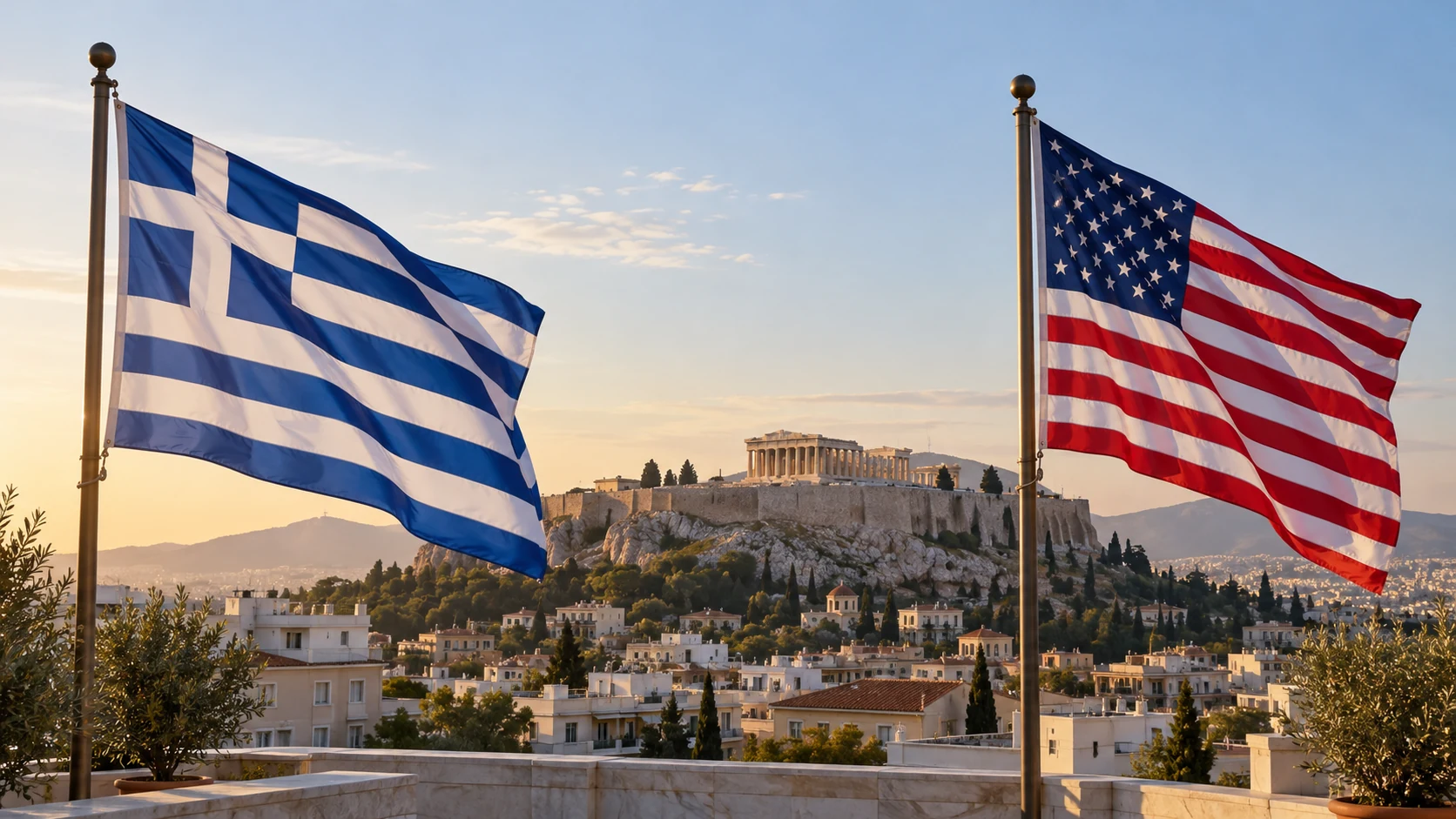
Marco Rubio's visit to Athens on 6–7 October 2026 highlighted a relationship that Washington wants to present both as a historical alliance and as a partnership with contemporary strategic value. At the sixth Strategic Dialogue and in his speech at the Pnyx on 7 October, the US secretary of state gave Greece a prominent place in his wider message about the transatlantic alliance.
This political review draws on public statements and the two governments' joint release. Descriptions of Greece are attributed to Rubio; the assessment of their significance is journalistic analysis.
An ally Washington considers indispensable
In his morning remarks, as reported by ERTnews, Rubio described Greece as an indispensable NATO ally and a pillar of regional stability. He linked the alliance's importance to uncertainty in Ukraine, the Middle East, Hormuz and the Red Sea.
His substantive point was that Greece is a country through which both American and Greek interests can be advanced. The emphasis on mutual interests gives concrete meaning to the diplomatic language of friendship: in his remarks, the relationship's value rests on cooperation in addressing shared challenges.
Ties extending beyond defence
Rubio listed trade, investment, energy and cultural exchanges as areas for deeper cooperation. He also referred to secure supply chains and critical minerals. Greece was presented as a partner of increasing importance for economic security as well.
The official Greek readout of the meeting at Maximos Mansion records a mutual willingness to broaden cooperation into technology, shipping and education. It also describes the Greek community in the United States as a bridge of friendship. This is the broader political picture of the relationship that the two governments sought to convey.
The Pnyx: historical affinity and a message to Europe
At the Pnyx, Rubio portrayed ancient Greece as a foundation of America's political and intellectual heritage. He also called modern Greece a “model ally” and expressed the hope that Europe would follow its example. He argued that the United States and Europe can become stronger together rather than treating cooperation as a contest in which one benefits at the other's expense.
The speech had a clear ideological dimension: he linked honour, duty and loyalty to one's country to the Trump administration's “America First” policy, as Reuters also reported. This was the US secretary's political argument, rather than an ideological position jointly agreed by the two countries.
Energy support, with sensitive issues still open
Responding to an ERTnews question about energy initiatives and interconnections, Rubio said Washington wanted the projects to succeed and that cooperation with Greece served both countries' national interests. He linked energy security to national security.
He acknowledged, however, that some issues involve other countries and require diplomatic handling. Public political support does not amount to a guarantee that every project will proceed, or to an announcement that all outstanding issues have been resolved.
The visit's political legacy
The joint statement of 7 October reaffirms the enduring relationship, shared democratic values and the intention to strengthen defence, trade, investment and cultural ties. Specific agreements are covered in AppiSToS's detailed report on the Strategic Dialogue.
As a political assessment, Athens received public recognition of its role from US diplomacy, while Washington presented Greece as an example of the alliance it seeks. The depth of this rapprochement will be judged through implementation of agreements, progress on projects and the handling of regional differences; warm language alone does not determine the outcome.
English translation of the Greek edition · Read in Greek