Hormuz: GFS PRIDE sinks; all 21 crew safely evacuated
MPA confirms the sinking following damage and a fire. GFS GISELLE reached a safe anchorage with all 22 crew safe.
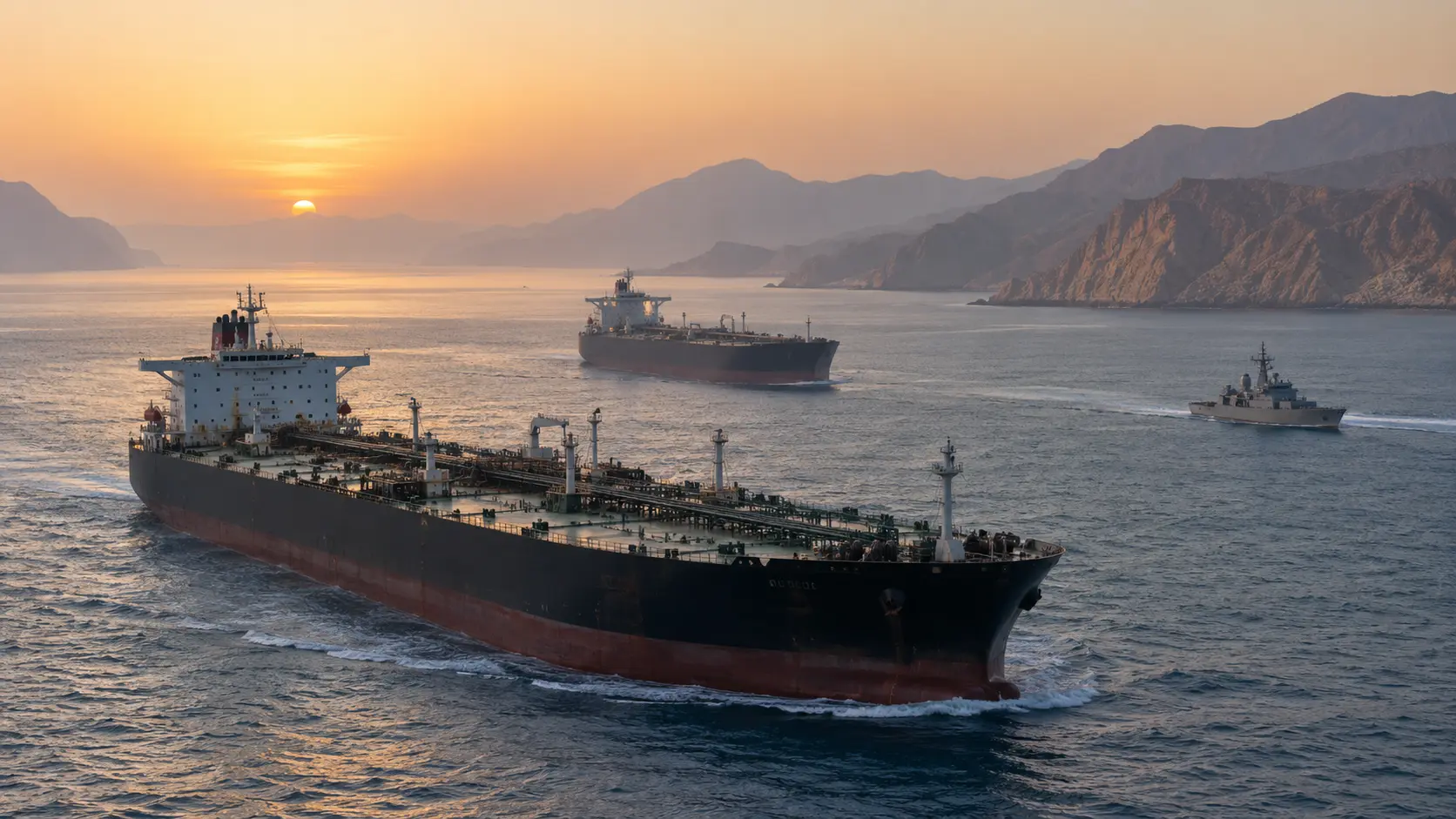
Update, 14 October 2026, 19:35 EEST — What changed: Singapore's Maritime and Port Authority (MPA) confirmed that container ship GFS PRIDE sank following damage and a fire. All 21 crew were safely evacuated, with no injuries reported.
GFS GISELLE sustained hull damage but reached a safe anchorage under its own propulsion. All 22 crew are safe.
MPA reports strikes by unknown projectiles while the vessels transited Hormuz on 13 and 14 October respectively, using Singapore dates. It identifies neither a perpetrator nor a projectile type.
Earlier updates
Update, 14 October 2026, 05:02 EEST — What changed: Reuters recorded at least five incidents involving tankers and other commercial vessels around the Strait of Hormuz over the previous 48 hours, including drone strikes. The count is based on maritime-security data and incidents reported to United Kingdom Maritime Trade Operations (UKMTO).
In the latest assessment cited by Reuters, the US-led Joint Maritime Information Center (JMIC) kept the threat to merchant shipping at severe, the second-highest level. JMIC said attacks, attempted attacks, uncrewed-aircraft overflights, targeted surveillance of merchant shipping and VHF hailing by Iran's Revolutionary Guards had continued.
Reports of a change in tactics
Two senior Iranian officials, who were not named, told Reuters that Tehran had changed the pace and type of its operations and intended to expand activity beyond the Strait into the Gulf of Oman and waters off Qatar and the United Arab Emirates. They linked the strategy to oil prices and the US midterm elections.
These are claims by the cited sources, not a public official Iranian announcement. Reuters said the US Pentagon and Iran's Foreign Ministry did not immediately respond to requests for comment. A possible complete closure of the Strait, mentioned by one official, is not presented as confirmed.
The oil market
In a separate Reuters update at 03:30 Athens time, Brent was up 0.8% at $106.58 a barrel and WTI was up 0.9% at $94.94. The move was attributed broadly to Middle East supply risks and expectations for Russian diesel flows; these are not Greek retail fuel prices.
Update, 12 October 2026, 04:00 EEST — What changed: The early rise in oil prices reversed within hours, illustrating the continued volatility in energy markets.
In Reuters' 03:42 Athens-time update, Brent was down 1.1% at $103.50 a barrel and US WTI was down 1.2% at $90.73. Brent had therefore moved away from its recent high of $109.97.
Why the market reversed
Attacks on shipping and aviation targets in the Gulf continued to support a high risk premium. At the same time, the prospect of renewed Russian diesel exports and reports of a possible Russia–Ukraine energy ceasefire temporarily eased supply concerns.
Reuters noted that the purported energy ceasefire had not been confirmed by either side. It should therefore be treated as an uncertainty, not as an agreed fact.
These figures are futures-market snapshots and are not Greek retail fuel prices.
Update, 12 October 2026, 03:08 EEST — What changed: Oil prices extended gains at the start of Monday as markets assessed the Middle East escalation and two tanker attacks reported over the weekend.
At 02:04 Athens time, Brent futures were up 0.73% at $105.48 a barrel, while US WTI was up 0.64% at $92.44, Reuters reported. These are futures-market snapshots and may already have changed.
The factors moving the market
Reuters linked the move to Houthi attacks on Saudi Arabia and two confirmed tanker incidents: a drone strike at the Sohar anchorage in Oman and an unknown projectile hitting another tanker transiting the Strait of Hormuz.
Goldman Sachs also raised its December Brent forecast to $90 from $85 a barrel. This is the bank's estimate, not a confirmed future price.
What this means — and does not mean — for Greece
The increase raises the risk of higher import, transport and refining costs, but it does not pass through automatically or at the same rate to pump prices. Product prices, the euro-dollar exchange rate, inventories, taxes and supply timing all intervene before retail prices are set.
Update, 11 October 2026, 04:08 EEST — What changed: US Central Command (CENTCOM) said a US fighter aircraft used a precision munition to strike the stern of the commercial vessel M/V Ocean Molica, also known as Arika Sun, in the Gulf of Oman.
According to the official US statement, the vessel is Panama-flagged, its propulsion was fully disabled and no crew member was injured.
CENTCOM's allegation and the unresolved details
CENTCOM alleges that the vessel had departed an Iranian port, ignored repeated warnings and attempted to breach the US-enforced naval blockade. These details are the US military command's account and had not been independently verified at the time of the update.
The precise location of the strike, the cargo, ownership and a full technical assessment of the vessel's condition had not been disclosed. “Naval blockade” reflects CENTCOM's wording and is not an independent legal assessment by AppiSToS.
Update, 11 October 2026, 03:02 EEST — What changed: United Kingdom Maritime Trade Operations (UKMTO), in Warning 162-26, said a tanker leaving the Strait of Hormuz was struck on its port side by an unknown projectile and caught fire.
According to the same warning, all crew members are safe. The extent of the damage and any environmental impact had not yet been established, while the vessel's identity and flag had not been disclosed.
What UKMTO confirms — and what it does not
The warning confirms the incident, the strike and the fire. It does not confirm the Iranian IRGC's earlier claim that the vessel struck a mine: UKMTO describes an unknown projectile and does not attribute responsibility. The precise cause and circumstances remain under investigation.
Update, 10 October 2026, 23:05 EEST — What changed: Iran's Islamic Revolutionary Guard Corps Navy (IRGC) announced that a crude oil supertanker suffered a powerful explosion and caught fire in the Strait of Hormuz.
According to the Iranian statement, the vessel struck a mine while attempting to leave the Strait on a route Tehran describes as “unauthorised and dangerous”. The IRGC also alleged that the ship's navigation and positioning systems had been switched off.
What has not been confirmed
At the time of the update, the vessel's identity and flag had not been disclosed. There was also no confirmed information on the crew, damage or any environmental impact.
The explosion and its alleged cause are reported on the basis of the IRGC statement, published by Iranian media and carried by ERTnews. No independent confirmation that the ship struck a mine had been located. This new claim should not be confused with a separate strike on another vessel recorded by UKMTO off the United Arab Emirates the previous day.
Update, 9 October 2026, 06:03 EEST — What changed: US President Donald Trump said he would not order a new attack on Iran before the 3 November midterm elections and said “productive discussions” with Tehran were under way.
The statement was made in a public post by the US president and reported by Reuters, Associated Press and ERTnews. No new ceasefire, nuclear agreement or final framework for reopening the Strait of Hormuz was announced. Iran was expected, according to the same reports, to respond to a US counterproposal within days.
Oil's immediate reaction
At 05:20 Athens time on 9 October, Brent futures were down 0.7% at $103.53 a barrel and US WTI was down 0.6% at $90.97, Reuters reported. The move was attributed to a partial easing of supply concerns after Trump's statement.
This is a futures-market snapshot, not a forecast for Greek pump prices. Prices can change quickly while attacks on vessels continue and uncertainty persists over flows from the Gulf.
A pre-election pause, not a peace agreement
Washington's time-limited commitment reduces the immediate risk of new US strikes until 3 November. It does not remove the documented threats to tankers or confirm that the two sides have agreed terms for safe transit through Hormuz.
Update, 8 October 2026, 17:57 EEST — What changed: UKMTO recorded a new incident about 51 nautical miles north of Madinat ash Shamal, Qatar, while Reuters reported warnings from sources close to Tehran that unauthorised oil-export routes would be obstructed.
The British maritime-security agency said a tanker had been struck by multiple projectiles. Reuters, citing maritime-security sources, identified the vessel as the Antigua and Barbuda-flagged chemical tanker Acers and reported minor crew injuries.
Iran's warning
A senior regional official close to Tehran told Reuters that Iran would regard any attempt by regional countries to open new export routes without its approval as hostile. A diplomat briefed by Tehran also referred to plans to obstruct such routes.
These statements were reported through anonymous sources and do not constitute a publicly issued Iranian legal measure. UKMTO's incident report confirms the strike on the vessel, but does not by itself attribute responsibility to a specific actor.
Higher risk for shipping
Reuters said the previous week saw the largest number of tanker attacks since the war with Iran began, while the number of vessels attempting to pass through the Strait fell to its lowest level in more than two months.
The new incident north of Qatar widens the geographic risk zone beyond the narrowest part of Hormuz. It does not prove that shipping has stopped altogether, but it increases operational risk for vessels, crews and insurers.
The earlier energy context
On 7 October, Brent had moved above $101 a barrel as markets weighed geopolitical and weather risks at the same time. That price was a futures-market snapshot, not a Greek retail fuel price.
Before the latest escalation, provisional vessel-tracking data showed that Middle East crude exports had exceeded pre-war levels on four of the seven days in the final week of September. Higher flows, however, did not amount to the restoration of safe navigation.
The picture remains mixed: cargoes continue to move, but more incidents and threats raise volatility and the risk of delays, rerouting and higher insurance costs.
English translation of the Greek edition · Read in Greek